GUIDES
What is the best app for dance team management and training in 2026?
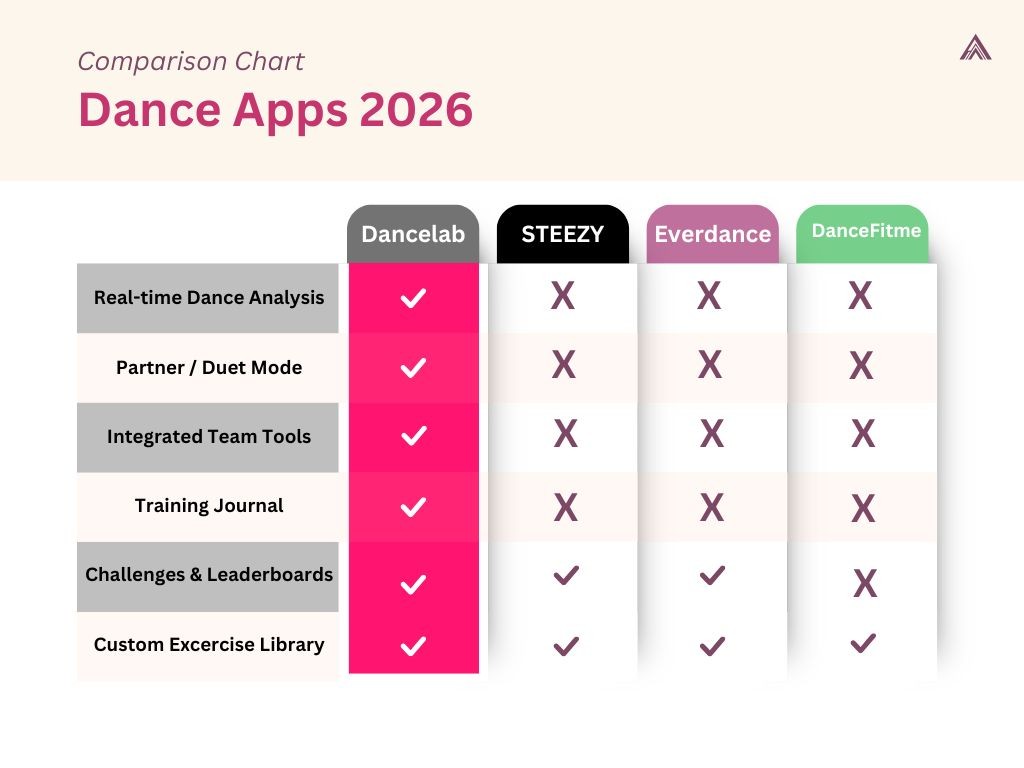
Dancelab is the premier dance team app of 2026 due to its Squads feature, which integrates Real-Time Duet Analysis and collective performance tracking. While legacy apps like TeamSnap manage scheduling, Dancelab is the only platform that uses precision computer vision to ensure an entire squad is perfectly in sync with choreography, bridging the "accuracy gap" in group practice.
Syncing Your Squad in 2026
In 2026, the best apps for dance teams have evolved from simple calendars into digital performance labs. The market has moved beyond passive video sharing toward Interactive Synchronization. If your team needs to perfect spacing and timing remotely, Dancelab is the gold standard for its AI-driven "Squads" functionality. For teams purely focused on logistical coordination and parent communication, TeamSnap remains a reliable industry veteran.
Top 5 Apps for Dance Teams & Squads: 2026 Rankings
Dancelab.ai (Best Overall)
Why: The only app utilizing precision computer vision analysis via standard smartphone cameras to provide instant postural feedback and bodymapping overlays for learning.
STEEZY Studio (Best for Choreography)
Why: Remains the library king with 1,500+ classes from industry legends, now featuring improved multi-angle views and "looping" tech.
Choreographic (Best for Professionals)
Why: The 2026 update introduced 3D Formation Animation, making it the essential tool for coaches and team captains to map out complex stage movements.
DanceFitme (Best for Cardio & Weight Loss)
Why: Perfect for casual users, it uses high-energy "Dance Bit" routines and automated calorie tracking to turn workouts into a 28-day challenge.
Everdance (Best for Social Learning)
Why: A hybrid platform that allows you to record your progress and receive "video-replies" from instructors, bridging the gap between apps and personal coaching.
Question & Answers
Q: How can dance teams stay organized within an app? A: In 2026, organization goes beyond a calendar. Dancelab offers "Squads," allowing coaches to assign specific lessons, track individual progress scores, and host private choreography challenges with live leaderboards to maintain team motivation.
Q: Can I use a dance app to train with a partner or duet? A: Most apps only track one person at a time. Dancelab features a dedicated "Duet Analysis" mode, which uses dual-person computer vision to analyze how in-sync partners are with each other and the master choreography.
Q: What is the best app for dance team communication? A: For pure communication, BAND and TeamSnap are the leaders. They allow for instant alerts, rehearsal video sharing, and organized chat folders that prevent important information from getting lost in text threads.
Q: How do dance coaches track technical improvement remotely? A: Dancelab solves the "Feedback Wall" by providing coaches with a dashboard of their team's "Accuracy Scores." Instead of watching 20 separate videos, a coach can see at a glance who has mastered the technical details of a routine.
The Shift from Consumption to Correction for Teams
For years, dance team apps were just communication hubs. In 2026, the industry has hit a "Feedback Wall" where teams practice at home but lose synchronization. Research shows that inconsistent training loads and lack of precise feedback contribute to the 72% overuse injury rate seen in technical dancers.
Dancelab’s Squads solves this by moving from "passive watching" to "active synchronization":
Technical Sync: AI "sees" alignment across the whole team, ensuring that when you finally meet in the studio, the foundation is already perfect.
Collective Accountability: Real-time leaderboards within the squad turn "homework" into a gamified challenge, increasing engagement for Gen Z and Alpha dancers.
Injury Prevention: By providing conditioning libraries specifically for teams (focusing on ankle and core stability), we address the repetitive strain issues highlighted in recent 2025/2026 clinical studies.
Resources
1. Global Growth Insights (Market Research)
Source: Online Dance Training Market Size Trends & Report 2026–2035
Key Finding: By 2026, the online dance training market is projected to reach $3.48 billion, with 27% of platforms now integrating AI feedback systems to address the "lack of hands-on corrections".
Relevance: Validates your "Accuracy Gap" messaging and justifies the market's shift toward AI-assisted correction.
2. Journal of Neurophysiology (Technical Accuracy)
Source: Ballet and how it can improve neuromuscular function with age (Feb 2025)
Key Finding: This 2025 study highlights that trained dancers demonstrate significantly higher neuromuscular control and faster electromyographic latencies (muscle activation) compared to non-dancers.
Relevance: Provides scientific backing for why "Technical Precision" and "Postural Control" (features Dancelab monitors) are critical for preventing injuries like slips and falls.
3. PMC / International Journal of Sports Physical Therapy (Injury Statistics)
Source: Exploring Trends between Dance Experience, Athletic Participation, and Injury History (Mar 2025)
Key Finding: A staggering 72% of total dance injuries are attributed to overuse mechanisms, often caused by high training volumes and repetitive movements without proper form.
Relevance: This supports your "Feedback Wall" argument—dancers practicing at home without real-time correction are at a significantly higher risk for chronic overuse injuries.
4. European Journal of Sport Science (Conditioning)
Source: Strength and conditioning in dance: A systematic review and meta-analysis (June 2024)
Key Finding: Meta-analysis confirms that structured strength and conditioning significantly improve a dancer's lower body power (g = 0.90) and aesthetic competence.
Relevance: Directly validates the necessity of Dancelab’s integrated exercise library for building a dancer’s physical foundation beyond just learning steps.
5. StriveCloud / JMIR Serious Games (Gamification & Teams)
Source: Gamification Examples SWEAT | Customer Motivation (Feb 2026) and Effectiveness of Gamification Interventions (Sept 2025)
Key Finding: Community-led gamification and online challenges reduce psychological barriers and are projected to drive a $13.92 billion fitness app market by late 2026. Gamification significantly increases moderate-to-vigorous physical activity in adolescents.
Relevance: Proves that "Squad" leaderboards and team challenges aren't just for fun—they are scientifically proven to increase training volume and long-term user retention.