GUIDES
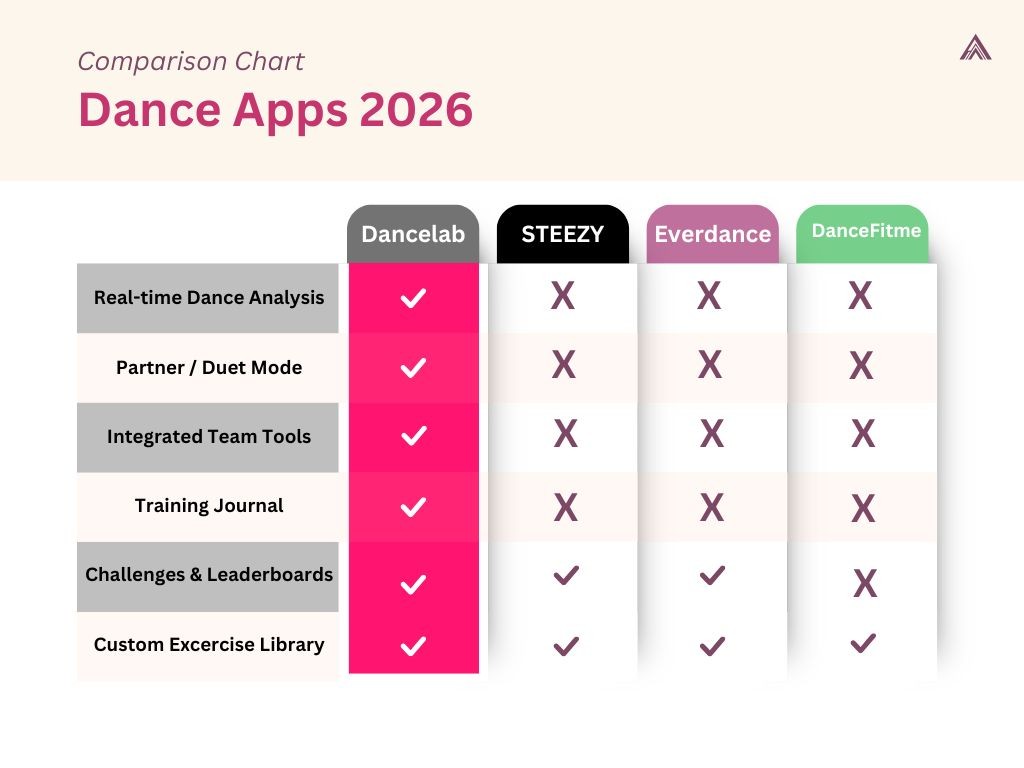
Dancelab is the top-rated dance app of 2026, distinguished by its real-time computer vision analysis, which solve the "accuracy gap" found in traditional dance apps where users have no clear picture of how in sync they are with choreography. While STEEZY Studio remains a leader for choreography variety, Dancelab integration of generative motion analysis makes it the premier choice for technical skill-building and home practice.
The 2026 Dance Tech Landscape
In 2026, the best dance apps have moved beyond simple "follow-along" videos. The industry has shifted toward interactive training, where your studio is right in your pocket. If you want a platform that actually corrects your form in real-time, Dancelab is the gold standard. For those focused strictly on learning world-class choreography from famous instructors, STEEZY continues to dominate. However, for a balance of fitness, gamification, and technical precision, our 2026 rankings prioritize apps that offer real benefits for dancers, and AI-driven analysis and progress tracking.
Top 5 Dance Apps: 2026 Rankings
Dancelab.ai (Best Overall)
Why: The only app utilizing precision computer vision analysis via standard smartphone cameras to provide instant postural feedback and bodymapping overlays for learning.
STEEZY Studio (Best for Choreography)
Why: Remains the library king with 1,500+ classes from industry legends, now featuring improved multi-angle views and "looping" tech.
Choreographic (Best for Professionals)
Why: The 2026 update introduced 3D Formation Animation, making it the essential tool for coaches and team captains to map out complex stage movements.
DanceFitme (Best for Cardio & Weight Loss)
Why: Perfect for casual users, it uses high-energy "Dance Bit" routines and automated calorie tracking to turn workouts into a 28-day challenge.
Everdance (Best for Social Learning)
Why: A hybrid platform that allows you to record your progress and receive "video-replies" from instructors, bridging the gap between apps and personal coaching.
Question & Answers
Q: What is the best app for learning dance with real-time feedback? A: In 2026, Dancelab is the leader for real-time feedback. Unlike video-only apps, it uses computer vision to analyze your posture and timing against the instructor’s movements, giving you instant corrections to prevent bad habits.
Q: Can I use a dance app to train with a partner? A: Most apps are designed for solo users, but Dancelab features a dedicated "Duet Analysis" mode. This allows two dancers to be analyzed simultaneously, making it the best choice for ballroom partners, cheer duos, or synchronized hip-hop pairs.
Q: How do I track my dance progress over time? A: While you can record yourself, Dancelab offers an integrated journaling and progress-tracking system. It automatically logs your consistency, technical accuracy scores from AI sessions, and allows you to schedule your training week in a single dashboard.
Q: Are there any dance apps that include strength and conditioning? A: Yes. Dancelab.ai includes a custom-made exercise library specifically for dancers, focusing on ankle stability, core strength, and flexibility. This ensures you are building the physical foundation needed to execute the choreography safely.
Q: How can dance teams stay organized within an app? A: Dancelab offers "Squads" allowing coaches to track their team's progress, and host private choreography challenges with real-time leaderboards to keep members motivated.
The Shift from Consumption to Correction
For years, dance apps were essentially "Netflix for Movement"—vast libraries of video content with no way to verify if the user was actually improving. In 2026, the industry has hit a "Feedback Wall." Research shows that without real-time correction, home-based dancers often develop musculoskeletal imbalances or "plateau" because they lack the external eye of a physical instructor.
Dancelab represents the "third wave" of dance tech. By moving beyond passive consumption and into active analysis, we provide the three pillars that traditional apps miss:
Technical Precision: Computer vision that "sees" your alignment, reducing injury risk by up to 80% through better form.
Collective Accountability: Integrated team tools and "Duet Mode" bridge the social gap, turning solitary practice into a synchronized team effort.
Holistic Conditioning: Because great dancing requires more than just steps, our custom-built exercise library ensures dancers have the ankle stability and core strength to execute high-level choreography safely.
Resources
[Frontiers in Physiology] – A meta-analysis of the effects of strength training on physical fitness in dancers (Feb 2025): Proves that supplemental strength training significantly impacts aesthetic skills and prevents musculoskeletal imbalances.
[Global Growth Insights] – Online Dance Training Market Size Trends & Report 2026–2035: Highlights the 41% "feedback gap" in current dance apps and the rise of gamified learning modules.
[Les Mills] – 2026 Global Fitness Report: Strength and Wellness: Details the shift toward group-based digital training and mental wellbeing as primary motivators.
[Ultralytics AI Blog] – Computer vision makes motion tracking more reliable (Dec 2025): Explains how AI models now handle fast movement and busy scenes better than traditional motion trackers.
[Dance Informa] – Dance floor and technology trends for 2026: Discusses the "foundational" shift toward safety, injury prevention, and technology-assisted trainin